Here are the main types of external pipe coatings used in the industry, along with their characteristics:
1. Fusion Bonded Epoxy (FBE) Coating
Description: Powder epoxy is applied electrostatically to heated pipe, then cured to form a hard, corrosion-resistant coating.
Advantages:
Excellent corrosion resistance.
Strong adhesion to steel.
Durable and resistant to soil stress.
Good for buried pipelines and moderate temperatures.
Limitations:
Limited UV resistance (not suitable for above-ground use).
Brittle at very low temperatures.
Common Use: Gas and oil transmission pipelines.

2. Three-Layer Polyethylene (3LPE) / Polypropylene (3LPP) Coating
Description: Multi-layer system consisting of:
FBE primer
Adhesive layer
Polyethylene (or polypropylene) topcoat
Advantages:
Excellent mechanical protection.
High corrosion resistance.
Good flexibility and impact resistance.
Suitable for aggressive environments.
Limitations:
More complex and costly than single-layer systems.
Common Use: Offshore pipelines, HDD (horizontal directional drilling), and areas with high mechanical stress.
3. Coal Tar Enamel (CTE)
Description: A traditional coating made from coal tar pitch, fillers, and fibers applied hot.
Advantages:
Good corrosion resistance.
Economical and long-standing usage.
Limitations:
Environmental concerns (toxic and carcinogenic).
Brittle and prone to cracking in cold climates.
Being phased out in many regions.
Common Use: Older pipelines, some water pipelines.
4. Bituminous Coating
Description: Asphalt-based coating, often applied to water and sewage pipelines.
Advantages:
Cheap and relatively easy to apply.
Provides basic corrosion resistance.
Limitations:
Limited durability.
Not suitable for high-temperature or high-pressure lines.
5. Polyurethane (PU) Coating
Description: Spray-applied or brush-applied coating forming a tough, flexible layer.
Advantages:
Fast curing.
Excellent adhesion and abrasion resistance.
UV-resistant (can be used above ground).
Limitations:
Higher cost.
Common Use: Both buried and above-ground pipelines.
6. Concrete Coating
Description: Often used as an overcoat on offshore pipelines (especially over 3LPE) to provide negative buoyancy and mechanical protection.
Advantages:
Prevents floating in subsea conditions.
Adds impact and crush resistance.
Limitations:
Very heavy, increases transportation and handling complexity.
Common Use: Offshore pipelines, river crossings.
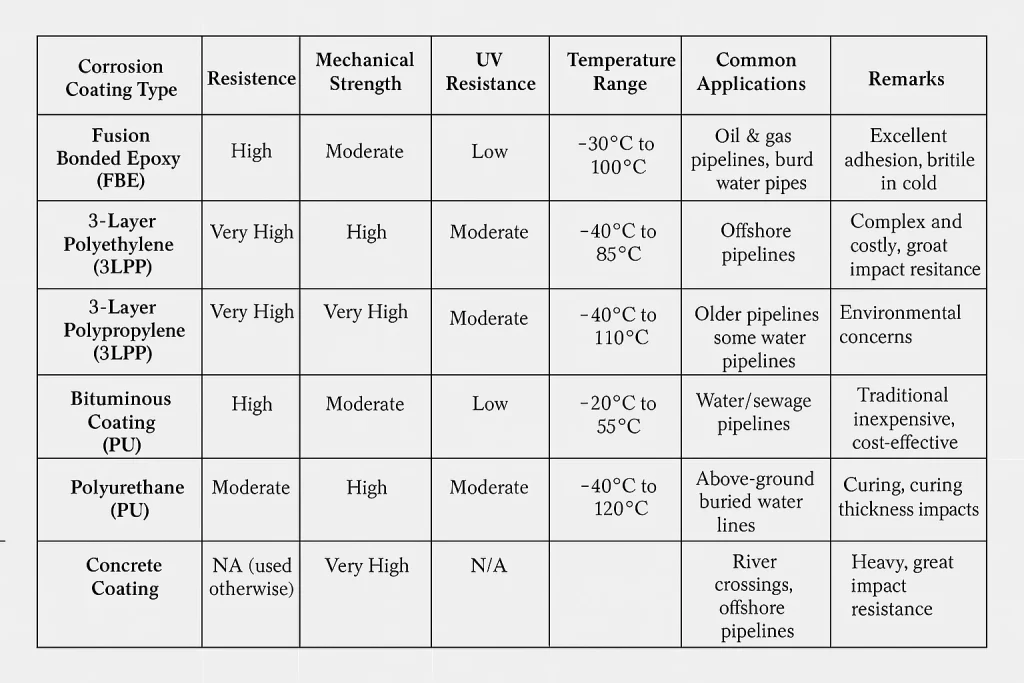
Here’s a comparison table summarizing the most common external pipe coatings: